This BBC guide to video aspect ratios is interesting, however despite extensive personal research on this subject, I’ve never encountered many their numbers anywhere else. Because of how much is now edited with desktop systems like Final Cut Pro, I think a great deal of this information should be noted and dismissed as archaic since these numbers will likely cause minor distortions with modern video tools.
Joe Maller.com
I’ve been listening music more or less exclusively as MP3s since sometime probably in 1998. Through that time I’ve been obsessive about metadata, all the additional information stored in files that gives them context and makes them searchable by existing tools. One thing that always bothered me was when an artist was sorted by their first name instead of their last name. So, in a fit of iconoclasticism* I decided that I’d gradually change the artist tags in all my MP3s to be last name first where appropriate.
This is a textbook lost cause.
So I hereby cede defeat. I never browse anymore anyway, I’ve just got too many songs and unique artist names. Either I listen on full random or use the iTunes search field to find songs.
Organizing by single genre still frustrates and baffles me, with few exceptions I largely ignore them.
* According to Google, this post is only the 107th use of the word ‘iconoclasticism’ on the web. Whenever this page gets indexed, I’ll have a Googlewhack for ‘iconoclasticism mp3‘.
Did I get ripped off?
- Me, May, 4, 2003:
- iTunes Music Store Player
- Not me, May 30, 2003:
- iTunes Music Store Player also here iTunes Music Store Player
It could just be a coincidence, but…
While answering an email recently, I couldn’t find a simple introductory CSS tutorial to link to. Here’s a good one: Wendy Peck’s CSS Primer
The declassified transcript of David Kay’s First Interim Progress Report to several Senate Intelligence committees seems to be completely different from whatever the NY Times article was talking about. Read the actual transcript, there’s a lot more being discovered in Iraq than is being reported. Actually most of the media accounts I read verged on willful negligence, these people don’t seem to be doing their jobs very well.
The last paragraph in the NY Times article does concede one astounding fact; of 130 known ammunition storage areas, 120, 92% have yet to be searched. Reading the Kay Transcript further emphasizes how enormous a task searching those areas will be, several are reported to exceed 50 square miles each. Even at a very conservative estimate, they’re still faced with searching several hundred square miles, a moderate estimate goes over a thousand square miles very quickly. They’re finding things like whole fighter jets buried in the sand: photo 1,
photo 2,
photo 3,
photo 4. Considering that a bunch of fully armed and fueled Luftwaffe fighter planes were discovered under Berlin’s Schönefeld airport in July of this year, 58 years after the city fell, jumping to conclusions about hidden weapons, either way, seems foolish.
Update: Andrew Sullivan posted a worthwhile summary of the Kay Report.
Imagine if everyone who was sued by the RIAA was able to collect double the damages. Trading files would be like playing the lottery. Since I’m no longer buying new CDs (downloads, used CDs or direct from artists), I suppose I can spare some of the money I’m saving. Lorraine Sullivan – Sued By The RIAA
Someone tell the NY Post about this.
Pretty soon I’m going to have to stop saying “I’m no good at math.” But then figuring this out took way too long:
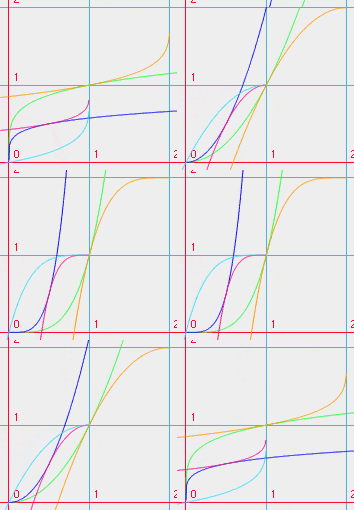
Graphs thanks to Graph-O-Matic. Well worth the $20. (Yes, this is filter related)
« Previous Page — Next Page »


