Over the weekend I got a letter from Cid of CIDtalk. “CID” is not an acronym, it’s a nickname (a unique shortening of Cindy).
Joe Maller.com
CIDtalk linked to Everything on my Desk and All Day Ice Cream (why do so many people think the name is All Day Ice Cream Cone instead of All Day Ice Cream?)
I’ve never visited the site before, but it looks interesting. Also, I think I really like the term “Observational-ist”, and might start using it even though it would probably sound pretentious in non-artsy company. I looked around a bit, but I couldn’t figure out who’s running the site or what “CID” stands for…
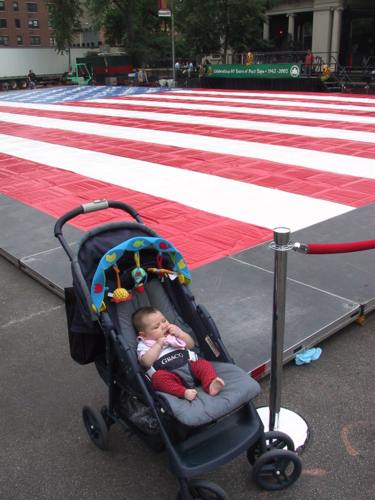
Lila and I took a moment to ogle “The World’s Largest Duck Tape Flag” at Union Square this afternoon. Lila was more interested in her fingers.
The flag was created by “Canadian Duct Tape Sculptor” Todd Scott, commisioned to help celebrate 60 years of duct tape.
From the official, city-sanctioned sign:
The World’s Largest Duck Tape U.S. Flag…
Measures 50 feet by 95 feet
Took over 150 hours to create
Equals the size of an NBA Basketball Court
Is over 13 miles of duct tape long
Equals over 1,120 rolls of Duck brand duct tape
Weighs over 500 pounds
Can seal Central Park from end to end five times
Can tape the Empire State Building 23 1/2 times.
 The Duck Tape products home page has more information about the duct tape flag and it’s also mentioned briefly in this week’s
Village Voice. Last weekend Mr. Scott appeared on the CBS Saturday Early Show where he was credited as the world’s only “professional duct tape sculptor.”
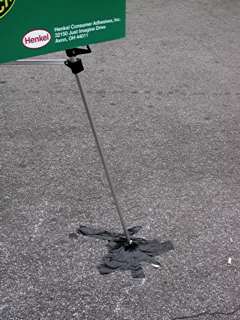
True to form, duct tape was employed to secure the easels holding up the signs.
Was the dirty-bomb suspect Oklahoma City’s John Doe #2
Bryan Preston has compiled a creepy, thorough and fascinating essay, that manages to be speculative without drifting into conspiracy theory. Executing McVeigh was a huge mistake. Were he rotting in a cell somewhere, at least he could be interrogated about potential connections to al Qaeda. There’s also a Metafilter discussion about the possible connection, with additional links.
10% of this essay may turn up on the evening news tomorrow or this weekend, and if anything is substantiated, 70% of it will show up on one of the prime-time news magazines. Regardless, big media news was stumped yet again.
How’s this for a crazy coincidence: Yesterday I linked to Enabling Virtual Hosts on MacOS X by Bob Davis. Today I got an email from Bob, who was visiting my site for Final Cut Pro information and saw the link. Amazing timing. Small world.
Bob mentioned that he likes helping people with computer stuff. Me too. Also, we both use three letter first names.
Last night I figured out how to get virtual hosts working locally with OS X’s built in Apache web server (Web Sharing). I was very close but what I didn’t know was virtual host declarations in the httpd.conf settings are only half of the process. On non-OS X machines, the second part involves modifying the computer’s “hosts” file to include the additional host names. OS X uses NetInfo to manage all that information and the edits need to be made using the NetInfo Manager application in the Utilities folder.
This site, Enabling Virtual Hosts on MacOS X contained nearly everything I needed to know and confirmed that most of my early explorations were well-directed. The one major hangup I had was that the two virtual hosts were both returning “403 Forbidden” errors when I tried to view anything in those directories. I spent about an hour twiddling with settings and chmod’ing the files and directories over and over before I came across this perfect explanation in Apache’s documentation:
In the case where file system permission are at fault, remember that not only must the directory and files in question be readable, but also all parent directories must be at least searchable by the web server in order for the content to be accessible.
I had mistakenly placed the site directories inside my Documents folder, which Apache didn’t have access to read. I’m still new at this Unix stuff, so I didn’t think to check the parent folders of the site directories, even though the concept is consistent with file sharing under OS 9. Anyway, moving the two website directories into the Sites folder, to which Apache has full read access, immediately cleared up the forbidden messages.
For the two test sites I’m working with, I decided to change their top-level domain from “.com” to “.joe”. So now if I want to see my local copy of this site I just open http://www.joemaller.joe in any web browser on this machine. The URL http://www.joemaller.com still goes to the live site on my ISP’s servers.
Using these modifications it’s possible to tell your computer to ignore the internet and load any URL from a local copy. Cool as this is, it has the potential to really screw up web access. Back up the configuration files and keep track of what you’re doing.
update: I forgot to link to Oreilly’s incredible series Apache Web Serving With Mac OS X, which I’ve been consulting repeatedly.
Region-Free DVD playback under Mac OS X came up when my friend Dave asked about watching a region 2 DVD of One Leg Kicking, a movie he filmed. Current software/firmware limits computer DVD players to five (5) region switches before the change is set as permanent.
DVD Region Codes are xenophobic, archaic and a nuisance, this information should be made widely available.
I haven’t had a chance to try these out yet, so I’m not sure if any of them work.
- Mac DVD Resource
- DVDRegion 1.5 a region modification tool available on VersionTracker.
- Region Free DVD Conversion
Another possibility might be the open source DVD player VLC, although it probably can’t do anything about region-based hardware lockouts.
I don’t think it’s illegal (under US Code Title 17, Chapter 12 §1201(k)(4)(D) — third paragraph from the bottom) for me to talk about this, although it might be illegal for a “non-professional” to use the linked applications. Whatever non-professional means. It amazes me a law like the DMCA was ever passed.
« Previous Page — Next Page »
